






Titanium Pipe Manufacturing: Problems You'll Actually Run Into and What to Do About Them
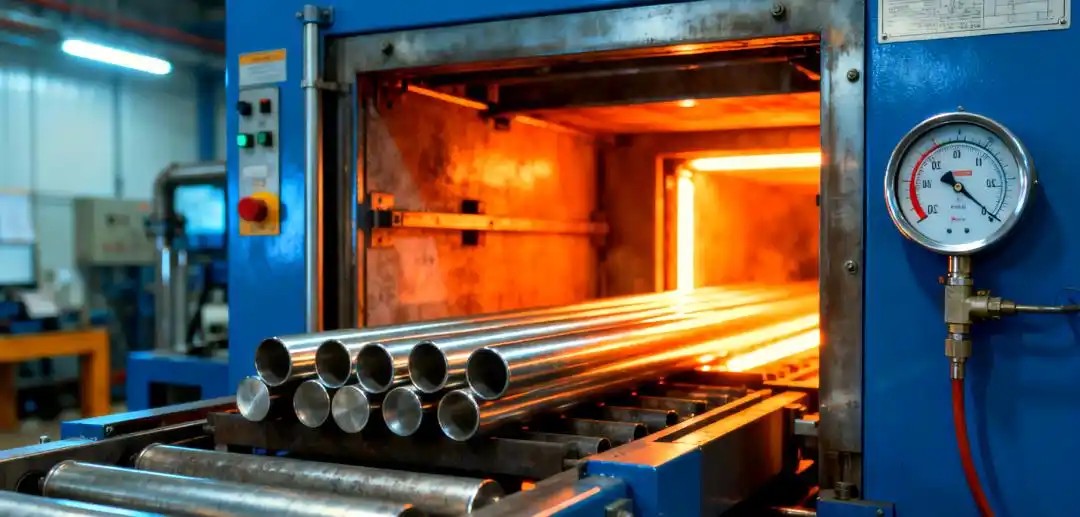
Let's Be Real About Titanium Pipes
Here's something people don't always appreciate. A titanium pipe is just a hollow cylinder. It's one of the simplest shapes you can make. So why does it cause so many problems?
Because simple shape doesn't mean simple manufacturing.
I've watched good production teams struggle with titanium pipes for years. The material fights you at every step. Heat it too much and you get brittle surfaces. Cool it too fast and it cracks. Look at it wrong and it work hardens. And the pipe geometry—long, thin-walled, hollow—makes every problem worse.
The issues in titanium pipe production aren't new. They've been around for decades. But knowing about them and knowing how to actually deal with them are two completely different things.
This is about what really happens on shop floors. Not textbook explanations. Real problems, real fixes, real lessons.
1. Before You Even Start: Alloy Problems
Here's a truth you learn fast in this business: garbage in, garbage out. If your starting material has problems, your pipe will have problems. You cannot fix bad chemistry with good processing.
1.1 Stuff That Shouldn't Be There
The worst defects start at melting. High-density inclusions, chemical segregation, brittle phases—all of these can form during vacuum arc remelting. Later, when you try to form that material into a pipe, these become crack starters .
The solutions exist but they're expensive:
Multiple vacuum arc remelting cycles
Slower melt rates with lower currents
Electron beam cold hearth melting for critical stuff
But here's the thing. Even with all that, inclusions happen. And when they do, you usually don't find them until ultrasonic testing. Or worse, until the customer finds them.
1.2 Different Alloys, Different Headaches
Every titanium alloy has its own personality during pipe production. Take Gr.12 titanium. Research on Gr.12 tube manufacturing found something interesting. The copper from tooling or sheaths could react with titanium during extrusion, creating titanium-copper eutectic phases—stuff that melts at lower temperatures and creates brittle spots on the pipe inner wall .
The fix? Switching from plain copper sheaths to steel/copper composite sheaths. Controlling extrusion temperature between 760-790°C. Keeping extrusion ratios under 18 .
2. Making the Tube Billet: Where Shape Begins
Before you have a pipe, you have a tube billet. How you make that billet sets the stage for everything that follows.
2.1 Two Roads, Two Sets of Problems
There are two main ways to make titanium tube billets, and both have trade-offs .
Extrusion gives you fine, uniform microstructure and good plasticity. But the equipment is expensive and complex. The process is slow. For higher-strength alloys, extrusion forces get enormous.
Rotary piercing (the Mannesmann process) is faster and cheaper. But you get coarser microstructure and lower plasticity. Surface quality can be okay, but internal structure is less uniform.
Your choice depends on what you're making. Thin-walled, high-precision pipes usually need extruded billets. High-volume standard sizes might use pierced billets. Either way, you're choosing which problems to deal with.
2.2 That Copper Problem Again
Remember the Gr.12 issue? During extrusion with copper sheaths, copper can diffuse into the titanium surface. Get temperatures too high or extrusion ratios too aggressive, and you get those low-melting-point eutectic phases on the inner wall .
The multi-layer sheath approach—copper outside for lubrication, steel inside to protect the titanium—solved it. Temperature under 790°C. Extrusion ratio under 18. With those controls, inner surface quality improved dramatically and tool life went up .
3. Heat Treatment: The Alpha Case Monster
If there's one problem that deserves special attention in titanium pipe production, it's alpha case.
3.1 What Alpha Case Actually Is
Alpha case is a diffusion reaction. It happens when titanium surfaces are heated in atmospheres containing oxygen, nitrogen, or carbon—mostly oxygen . Above about 480°C, air or water vapor starts producing alpha case. Below about 550°C, oxygen mobility is limited and case depth stays shallow. But go higher, and alpha case grows fast.
Why is this bad? Alpha case is brittle. It has a completely different structure than the base metal. In service, it cracks. And once it cracks, those cracks can run into the sound metal underneath .
For pipes, alpha case is especially nasty because:
It forms on both inside and outside surfaces
Thin walls have less margin for surface defects
Internal surfaces are hard to inspect
You can't easily machine it out of long pipe lengths
3.2 What Causes It During Heat Treatment
Most production vacuum furnaces use graphite felt insulation and graphite heating elements. At lower temperatures in vacuum, water vapor is the main concern—it breaks down and oxidizes titanium. Water vapor is notoriously hard to pump out at low temperatures .
As temperature climbs, water vapor decreases but CO₂ and CO increase, providing more sources for alpha case formation. At typical heat treatment temperatures for titanium (1450-1750°F / 788-954°C), all these reactions are active .
3.3 Color Doesn't Tell You Much
Here's something that surprises a lot of people: you cannot reliably detect alpha case by looking at color. Industry often uses color as a post-weld or post-heat-treatment check, but research shows color doesn't correlate well with actual alpha case presence . Samples with similar colors had different case depths. Samples with different colors sometimes had similar case depths.
The only reliable way to find it is metallographic examination—cutting, polishing, etching, and looking under a microscope. Alpha case shows up as a white-appearing zone at the surface .
3.4 Keeping Alpha Case Under Control
Standard practice for minimizing alpha case includes :
Initial pumpdown to 1×10⁻⁴ torr or lower (per AMS2769)
Slow ramp rates (around 600°F/hr)
Temperature holds if outgassing exceeds certain pressures
Clean vacuum furnace environments
These procedures hurt production time, but they're necessary for high-integrity pipes. Some shops use chemical milling (acid pickling) after heat treatment to remove any alpha case that formed. For critical aerospace and medical work, this is standard practice.
4. Rolling and Drawing: Forming Problems
Once you have a tube billet, you need to turn it into a finished pipe. That means multiple passes of rolling or drawing, with intermediate anneals. And every pass brings new opportunities for defects.
4.1 How Much Deformation Is Just Right?
Deformation amount is critical. Too little—below about 40%—won't break up the coarse cast structure. You end up with large, unrecrystallized grains that hurt mechanical properties .
Too much deformation creates its own problems. Excessive per-pass deformation increases forming resistance. The heat generated can cause localized temperature spikes, leading to non-uniform deformation and abnormal grain growth .
For Gr.12 titanium, research found that keeping per-pass deformation under 52%, with initial pre-rolling deformation under 35%, produced consistent surface quality and minimized cracking .
4.2 Cracks During Rolling
Cracks can show up during rolling for many reasons. In large-diameter Ti-4Al-3Mo-1V seamless pipes undergoing flattening tests, cracks consistently appeared at the 6 o'clock and 12 o'clock positions on the inner surface .
What happened? During heat treatment, an oxide film had formed on the pipe surface. This oxide layer increased surface hardness, creating localized stress concentrations during flattening. When the pipe was flattened, tensile stresses at those positions exceeded the weakened surface layer's capacity .
The fix was simple: acid pickling to remove the hardened surface layer before flattening. With the brittle layer gone, the pipes flattened without cracking.
4.3 Springback in Cold Forming
Titanium has a high yield-to-tensile ratio, which means it springs back significantly after bending. For cold-formed pipes—like titanium alloy coiled tubing for oil and gas—this springback makes geometry control difficult .
Researchers studying TA4 titanium coiled tubing (Φ50.8×4mm) found that the thickness-to-diameter ratio had to stay within a specific range. Too high led to edge cracking during roll forming. Too low led to excessive springback. Roll positioning also affected contact conditions and stress distribution .
The solution was detailed process design using finite element simulation—21-pass roll forming sequences, optimized flower patterns, careful control of strip edge projection .
4.4 When Ultrasonic Testing Says No
Even with good processing, some pipes fail ultrasonic inspection. For Gr.12 titanium, researchers found that with optimized processes—proper pre-rolling, controlled per-pass deformation, careful heat treatment—ultrasonic qualification rates could reach above 95% .
That 5% failure rate is just reality. No matter how good your process, some pipes won't make it through inspection.
5. Lubrication: Keeping Things Moving
Titanium does not slide nicely over tooling. When it's hot, it wants to gall, seize, and weld itself to whatever it touches.
5.1 Why Lubrication Matters
Good lubricants do several things :
Reduce forming forces
Protect surface quality
Prevent localized overheating
Extend tool life
Bad lubrication—or uneven lubrication—creates surface defects, tool wear, and inconsistent deformation.
5.2 Matching Lubricant to Process
Different forming processes need different lubricants. Hot extrusion of titanium often uses glass lubricants that melt and form a continuous film between the titanium and the die. Cold drawing might use conversion coatings plus soap lubricants.
The key is matching the lubricant to the alloy and the process. What works for Gr.2 commercially pure titanium might fail completely for Ti-6Al-4V. What works for extrusion might be useless for drawing .
6. Extrusion Die Design: Angles Matter
For extruded titanium seamless tubes, die design is critical. And it's not always intuitive.
6.1 What Actually Makes a Difference
Research using finite element analysis on titanium tube extrusion found that not all die design parameters are equally important .
The corner radius at the die entrance and the die angle had significant effects on extrusion load and die stress. But the corner radius at the exit and the land length? Negligible effects .
For the specific extrusion process studied, researchers recommended:
Die angle of 60 degrees
Corner radius at die entrance between 10 and 15 mm
These parameters balanced extrusion load, die stress, and metal flow .
6.2 How Dies Fail
Extrusion dies fail in two main ways :
Early fracture from maximum principal stress
Severe deformation from von Mises stress exceeding yield
Proper die design distributes these stresses and extends die life. For titanium extrusion, where temperatures are high and forces are large, die life is always a concern.
7. Welding: Joining Problems
Many titanium pipes are welded—either during manufacturing (welded pipe) or during installation (joining pipe sections). Welding brings its own set of headaches.
7.1 Why Titanium Welding Is Hard
Titanium's chemical reactivity means it absorbs oxygen, nitrogen, and hydrogen from the atmosphere when hot. These elements embrittle the weld. At the same time, titanium's low thermal conductivity means heat builds up in the weld zone .
The combination leads to common welding defects:
Porosity from trapped gases
Cracking from embrittlement
Contamination from inadequate shielding
Alpha case formation in the heat-affected zone
7.2 Shielding: You Can't Skimp
Proper shielding for titanium welding is extensive :
Primary shielding from the torch
Trailing shielding to protect cooling weld metal
Backing shielding for the root side
Purge chambers for complex geometries
For critical applications like Navy seawater piping systems, welding procedures must be qualified, welders must be certified, and every weld gets inspected .
7.3 Inspection After Welding
Weld inspection typically includes visual examination (looking for color—straw, blue, or gray indicate contamination), radiographic or ultrasonic testing for internal defects, and sometimes dye penetrant for surface cracks .
The standard for Navy applications is demanding: "first quality workmanship" with mandatory requirements for acceptance .
8. Service Problems: When Pipes Fail in the Field
Even perfectly made pipes can fail in service if the application conditions aren't understood.
8.1 Titanium Can Still Corrode
Titanium has a reputation for corrosion resistance, and it's largely deserved. But it's not zero. Studies of pure titanium condenser tubes after 15 years of service found severe corrosion perforation on both inner and outer surfaces, plus edge cracking .
The lesson? Titanium is highly corrosion-resistant, but not corrosion-proof. Service environment matters. Flow rates, temperatures, and chemistry all affect long-term performance.
8.2 Fabrication Issues
During installation, titanium pipes often need bending, welding, and end preparation. Each operation introduces risk :
Bending: high springback makes geometry control difficult
Welding: requires expensive equipment and strict contamination control
End preparation: machining titanium is slow and tool-intensive
These fabrication challenges limit titanium pipe use despite the material's advantages. For thin-walled pipes, long pipes, or high-strength requirements, the production difficulty translates directly to cost .
9. Real Stories from the Shop Floor
Case 1: Gr.12 Tube Troubles
A manufacturer kept having inconsistent surface quality in Gr.12 titanium tubes. Extruded billets showed inner wall defects, and finished tubes had high rejection rates during ultrasonic inspection .
Investigation found multiple issues:
Copper sheaths were creating titanium-copper eutectic phases on inner surfaces
Extrusion temperatures were too high
Extrusion ratios were too aggressive
Rolling passes had excessive per-pass deformation
Tooling hardness and surface finish were inconsistent
The fixes were systematic :
Switched from single copper sheaths to steel/copper composite sheaths
Controlled extrusion temperature to 760-790°C
Kept extrusion ratio under 18
Added pre-rolling with Q≤0.1, ε≤35%
Limited per-pass rolling deformation to ≤52%
Maintained tooling hardness >HRC35 and surface roughness <Ra1.6μm
Results: cracking rate during rolling and straightening dropped to <1‰, ultrasonic inspection qualification rate exceeded 95%.
Case 2: Pipes That Cracked in Testing
A batch of large-diameter Ti-4Al-3Mo-1V seamless pipes kept failing flattening tests. Cracks appeared on the inner surface at consistent locations .
Finite element simulation showed that during flattening, the 6 o'clock and 12 o'clock positions experienced the highest tensile stresses. Metallographic examination revealed an oxide layer on the pipe surface from heat treatment—classic alpha case .
The oxide layer increased surface hardness, creating localized stress concentration. Under flattening loads, the brittle layer cracked, and cracks propagated.
The solution? Acid pickling to remove the hardened surface layer before flattening. With the alpha case gone, pipes passed flattening tests consistently .
Case 3: Coiled Tubing Development
For oil and gas applications, titanium alloy coiled tubing offers advantages in deep wells with severe conditions. But roll forming titanium into coiled tubing presents challenges: high springback, edge cracking, surface wear .
Engineers used finite element simulation to design a 21-pass roll forming process for TA4 titanium tubing (Φ50.8×4mm). They found that thickness/diameter ratio had to stay within an effective range—too high led to edge cracking, too low led to excessive springback .
Roll positioning affected contact conditions and stress distribution but didn't significantly change final tube geometry. With optimized design, trial production matched simulation results .
10. What Experience Teaches
If you're making titanium pipes, here's what matters.
Start right. Multiple melts, controlled compositions, thorough ingot inspection—these prevent problems you can't fix later .
Control your billet process. Whether extruded or pierced, billet quality determines everything. For critical stuff, extrusion gives better microstructure .
Watch alpha case constantly. Heat treatment in uncontrolled atmospheres creates brittle surfaces that crack under load. Vacuum furnaces, slow ramp rates, acid pickling—use them all .
Respect deformation limits. Too little leaves coarse structures. Too much causes cracking and non-uniform properties. Know your alloy's limits and stay within them .
Lubricate properly. Titanium will gall and seize without good lubrication. Match the lubricant to the process and the alloy .
Design tooling carefully. For extrusion, die angle and entrance radius matter most. Small changes can significantly affect extrusion load and die stress .
Expect some losses. Even with optimized processes, 5% ultrasonic rejection rates are realistic . Plan for it.
The Bottom Line
Titanium pipe production isn't forgiving. The material is sensitive, the processes are complex, and the hollow geometry creates unique challenges. Problems happen—inclusions, alpha case, cracking, springback, lubrication failures, die wear, welding contamination.
But here's the thing. These problems are understood. They have causes, and they have solutions. The shops that succeed aren't the ones that never see problems. They're the ones that know what to expect, have plans for dealing with it, and learn from every batch.
Titanium doesn't give you breaks. But if you respect what it demands, titanium pipes deliver performance nothing else can match.
Navigation
 How can the service life of titanium plates be extended under harsh working conditions17/04/2026
 Chaoyang accelerates its ¥1.2B small-particle sponge titanium investment, with 50kt capacity boosting aerospace.16/04/2026
 Deeply engaged in the manufacturing of titanium equipment, we safeguard the development of the industry with advanced equipment and practical cooperation15/04/2026
 A New Chapter in Titanium Alloy Applications: Titanium Combs from Aerospace to Hair Care13/04/2026

Send Us A Message