






Pushing the Boundaries: How Big Can You Actually Forge a Titanium Tube?
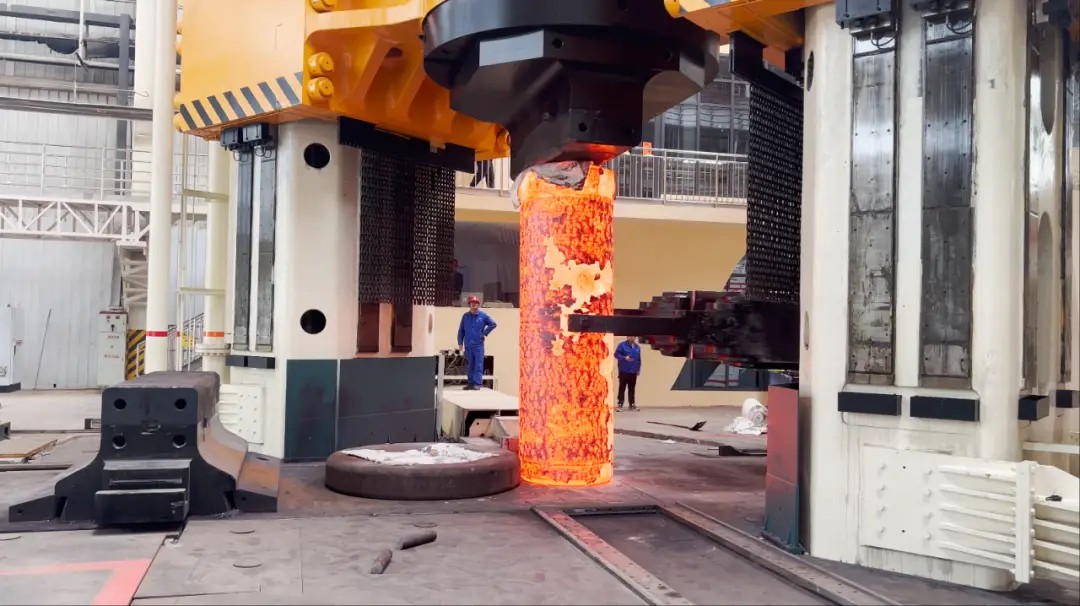
Ask an engineer to name a metal that's both strong and light, and they'll usually point straight to titanium. Ask them to name something that's difficult to forge into giant tubes, and they'll probably point to the same material.
Titanium isn't like steel. You can't just heat it up, push it through a die, and call it a day. It fights back at every step. It holds onto heat instead of letting it spread, it reacts with oxygen if you're not careful, and it requires equipment that most factories don't have. So when someone asks "how large can you forge the thickest titanium tube?", the answer depends less on what's theoretically possible and more on what's been proven.
But here's the thing: every few years, someone pushes that boundary further. And the current record is bigger than most people realize.
The Current Crown Jewel: The 700mm Extruded Titanium Tube
Let's start with the biggest one that actually exists.
In 2020, a manufacturer called SYZT used their 68,000-ton multifunctional extrusion and die forging press—developed in partnership with Tsinghua University—to produce a seamless titanium alloy pipe with an outer diameter of 700mm, an inner diameter of 430mm, and a length of 6.5 meters [8†L24-L28]. That's a pipe with a wall thickness of 135mm (just over five inches), made from titanium.
To put that in perspective: imagine a pipe big enough for a person to crawl through, with walls thicker than your wrist, made from a metal that most shops struggle to machine at any size. That pipe currently holds the title of the largest diameter pipe extruded from titanium in the world [8†L15-L16].
Why does this matter? Because before this, extruding a titanium tube of this diameter was considered impractical. The 68,000-ton press—the only machine of its kind that combines both extrusion and die forging capabilities—changed what was possible. And the pipe wasn't a stunt. It was designed for demanding applications in military equipment, thermal power, and nuclear power, where failure isn't an option [8†L33-L35].
But here's the catch: not everyone has a 68,000-ton press sitting in their backyard. For most manufacturers, the commercially available limits are smaller.
Breaking Down "Large": Diameter, Wall Thickness, and Length
When engineers talk about a titanium tube being "large," they're usually thinking in three dimensions. Each has its own limits, and each depends heavily on how the tube is made.
Outer Diameter (OD) — Seamless vs. Welded
For seamless forged titanium tubes, the commercially available range typically tops out around 500–600mm in OD. A major breakthrough came in 2023 when researchers successfully developed a Φ610mm TC4 titanium alloy hot-rolled seamless tube using a process that combined forging, rolling, and extrusion on a Pilger pipe mill [9†L2-L5]. This was significant because it expanded the upper limit of OD for titanium alloy hot-rolled seamless tubes from 219mm to 610mm in a single leap [14†L10-L12].
For welded titanium tubes, the OD can go much larger—up to 2000mm (2 meters) or even beyond, depending on the application [3†L30-L31]. But welded tubes aren't forged. If you need a seamless forged tube, the diameter is significantly more constrained.
Wall Thickness — The Thick-Walled Challenge
Wall thickness is where titanium forging really shows its capabilities. For hot-extruded titanium tubes, commercially available wall thicknesses range from 3mm to 35mm, with outer diameters from 50mm to 609mm and lengths up to 8000mm [1†L45-L47]. The record-holding 700mm OD tube pushed that to 135mm.
But there's a nuance: the ratio between diameter and wall thickness matters. Tubes with larger diameters and thinner walls are much harder to produce without defects like ovalization or wrinkling. The D/t ratio (diameter divided by wall thickness) is a key metric; higher ratios mean more challenging production. For large-diameter, thin-wall pipes—typically defined as OD ≥300mm with wall thickness ≤5mm—the technical challenges multiply exponentially [10†L7-L10].
Length — How Long Can You Go?
Length is surprisingly flexible. Titanium tubes can be produced in lengths exceeding 18,000mm (18 meters) for certain applications [3†L10-L11]. The world-record extruded tube was 6.5 meters long, but there's no fundamental reason longer lengths couldn't be produced with larger equipment.
However, longer tubes typically come from welded rather than forged seamless processes. For cold-rolled seamless titanium tubes, standard lengths range from 2000mm to 9000mm depending on diameter [0†L24].
The Methods: How You Forge Changes What You Can Get
Not all forged titanium tubes are created equal. The production method directly determines the maximum size you can achieve. Here's how the different approaches stack up.
Hot Extrusion — The Heavyweight Champion
Hot extrusion is the method behind the 700mm OD record. A heated titanium billet is forced through a die under enormous pressure, creating a seamless tube with consistent wall thickness and excellent material properties [12†L7-L9].
The advantage? Uniform grain structure, superior mechanical properties, and the ability to produce thick walls. The disadvantage? You need a massive press. The 68,000-ton machine used for the record is in a league of its own. Most commercial extruders operate in the 1,000 to 10,000-ton range, which limits maximum OD to around 300–400mm.
There's another catch: when using hot extrusion to produce pipe blanks, the extrusion process requires leaving a billet head, resulting in low material utilization. And the high deformation resistance of titanium alloys requires high-tonnage extrusion equipment, which also limits production [1†L31-L35].
Rotary Piercing + Pilger Rolling — The Cost-Effective Alternative
This is where things get interesting. For applications that don't require extrusion-level wall thickness, rotary piercing combined with Pilger rolling offers a more cost-effective path to large-diameter seamless titanium tubes.
The rotary piercing process (also known as the Mannesmann process) uses oblique rollers to spin a heated billet while a piercing mandrel creates the hollow center [4†L6-L9]. This produces a thick-walled tube that can then be hot rolled using a Pilger mill to achieve final dimensions.
The breakthrough Φ610mm TC4 tube was developed using exactly this approach—rotary piercing followed by Pilger rolling—which not only achieved the large diameter but also significantly lowered manufacturing cost and production time because the major deformation steps only required two operations [9†L12-L15]. Large-sized titanium alloy seamless pipes are commonly produced by either "piercing–rolling" or "extrusion–rolling" routes [11†L25-L27].
Ring Rolling — The Special Case for Massive Diameters
If your "tube" is actually more like a ring or a short cylindrical component, ring rolling offers dramatically larger size capabilities.
Seamless rolled titanium rings can be produced with outer diameters from 300mm to 3500mm (3.5 meters), with wall thicknesses up to 200mm and heights up to 800mm [15†L20-L21]. One manufacturer reports producing titanium rolled rings with diameters from 100mm to 2000mm, and another with capacities reaching up to 3500mm [15†L17-L21].
The process starts with a circular preform that is upset and pierced to create a hollow "doughnut," then rolled between two rotating rollers to increase the diameter while reducing wall thickness [5†L12-L14]. While not a "tube" in the traditional sense, ring-rolled components serve similar functions in large-diameter applications like aero-engine casings, offshore platform flanges, and pressure vessels.
What's Commercially Available vs. What's Custom
Here's a practical breakdown of what you can actually order, versus what requires a custom R&D project.
If your requirements fall within the "Standard" column, you can likely find a supplier with off-the-shelf or short-lead-time options. If you need the "Custom" range, expect long lead times (6–12 months), significant engineering investment, and a price tag 3–10 times higher than standard sizes.
The Real Limiting Factors
So why can't you just call up a manufacturer and order a 1-meter diameter, 200mm wall forged titanium tube tomorrow? Several factors impose hard limits.
Equipment Capacity — The Press Ceiling
The single biggest limitation is press size. Titanium requires significantly higher forces than steel to deform because it retains strength at high temperatures and has poor thermal conductivity, which keeps heat concentrated in the work zone [1†L31-L35].
The 68,000-ton press that produced the record tube is currently among the world's largest for this type of work. However, there are even larger presses available. VSMPO, a major titanium producer, operates forging presses with capacity ranging from 3,000 tons all the way up to 75,000 tons, which is reportedly the highest capacity forging press in the world [16†L5-L8]. Only a handful of facilities globally can produce titanium tubes above 500mm OD.
Billet Quality and Size
You can't make a large tube from a small billet. Titanium ingots can be produced in sizes up to several tons, but the larger the ingot, the higher the risk of internal defects like segregation, porosity, and inclusions. Producing a defect-free titanium billet suitable for large-diameter tube forging requires vacuum arc remelting (VAR) , often in multiple stages.
Wall Thickness Uniformity
Maintaining consistent wall thickness across a long, large-diameter titanium tube is one of the hardest challenges in metal forming. Ensuring millimetre-level consistency in wall thickness across a large cross-section requires highly precise equipment, die design, and process control—the slightest deviation creates weak points [10†L13-L15].
Material Grade Matters
Different titanium alloys behave very differently under forging conditions.
Commercially Pure (Grade 1–4): Most formable, but lower strength. Can be forged at lower temperatures and with less force.
Ti-6Al-4V (Grade 5): The workhorse alloy, accounting for the majority of titanium alloy consumption. Requires forging temperatures around 900–1,000°C and significant force. The record 700mm tube is Ti-6Al-4V.
Beta Alloys: More formable at room temperature after heat treatment, but less common and more expensive.
If you need the highest strength, you're working with an alloy that's harder to forge. That limits size.
The Thin-Wall Frontier: A Different Kind of "Large"
While we've focused on thick-walled tubes, there's another direction in the titanium tube world that's equally impressive: large-diameter, thin-wall seamless pipes.
In 2025, manufacturers successfully developed large-diameter, thin-walled seamless titanium tubes in specifications like φ368×5.5×6000mm, φ219×5×6000mm, and φ140×3.5×6000mm [0†L35-L37]. These represent the cutting edge of balancing "large" with "thin."
The challenge here is different. When you combine large-diameter (≥300mm) with thin-wall (≤5mm) , traditional rolling or extrusion puts immense radial force on the thin walls, causing instability, wrinkling, or even tearing [10†L11-L13]. Manufacturers have overcome this using multi-stage, temperature-controlled hot extrusion combined with powerful back-pressure or internal mandrel support, which acts like a "skeleton" to prevent collapse [10†L20-L22].
The payoff? Up to 40% weight savings compared to conventional solutions, which is crucial for aerospace and deep-sea structures where saving every kilogram matters [10†L30-L31].
Why Would You Need a Tube This Large?
Given the cost and complexity, large-diameter, thick-walled titanium tubes are only used where no other material will work. Common applications include:
Desalination plants: Seawater is brutally corrosive. Titanium is one of the few materials that survives long-term in seawater environments [7†L20-L22].
Offshore oil and gas: Deep-sea pipelines and risers require the combination of strength, light weight, and corrosion resistance that only titanium provides [7†L20-L22].
Chemical processing: Heat exchangers, condensers, evaporators, and reactors handling aggressive acids and alkalis depend on titanium for long-term reliability [7†L37-L39].
Nuclear and thermal power: The 700mm record tube was specifically designed for these applications, where failure is not an option [8†L33-L35].
Aerospace structural components: Landing gear, engine casings, and airframe elements increasingly use large titanium components [17†L35-L36].
Submarines and deep-sea equipment: Pressure hull components and seawater systems demand titanium's combination of light weight and corrosion resistance [7†L33-L35].
In all these cases, the lifecycle cost of a titanium component—even an extremely large and expensive one—is lower than using a cheaper material that requires frequent replacement.
So, How Large Can You Actually Go?
The honest answer: as large as you can afford, and as large as the available equipment can handle.
For most commercial applications, forged titanium tubes up to 500mm OD with 35mm walls are available without extraordinary measures. Hot-extruded titanium tubes are commercially available with outer diameters from 50mm to 609mm, wall thicknesses of 3mm to 35mm, and lengths up to 8000mm [1†L45-L47].
For the truly massive—700mm OD with 135mm walls—there's a proven manufacturing pathway, but it involves a global search for the few facilities with the right equipment and expertise. And if you need something even larger? That's where welded tubes (up to 2000mm OD) or ring-rolled components (up to 3500mm diameter) take over.
The limits of titanium tube forging aren't fixed. In 2023, the OD limit for hot-rolled seamless tubes jumped from 219mm to 610mm [9†L4-L5]. In 2025, manufacturers produced new large-diameter thin-wall specifications [0†L35-L37]. Every few years, someone pushes the boundary further.
The only real question is: how large do you need to go?
Navigation
 How can the service life of titanium plates be extended under harsh working conditions17/04/2026
 Chaoyang accelerates its ¥1.2B small-particle sponge titanium investment, with 50kt capacity boosting aerospace.16/04/2026
 Deeply engaged in the manufacturing of titanium equipment, we safeguard the development of the industry with advanced equipment and practical cooperation15/04/2026
 A New Chapter in Titanium Alloy Applications: Titanium Combs from Aerospace to Hair Care13/04/2026


Send Us A Message