






Titanium Forging Market Trends: A Concise Industry Overview
Introduction
Titanium forgings deliver exceptional strength-to-weight ratios, corrosion resistance, and biocompatibility for critical applications across aerospace, medical, and industrial sectors. This overview captures the essential trends shaping the market today.
Key Alloys and Applications
Market reality: Ti-6Al-4V dominates with ~50% of global titanium usage, while beta alloys gain traction for specialized applications requiring lower elastic modulus .
2. Game-Changing Technologies
FAST-Forge: The Cost Revolution
Traditional titanium processing wastes 90% of material—only 1kg of 10kg becomes final product . FAST-Forge (Field Assisted Sintering Technology + one-step forging) transforms this by:
Consolidating powder and machining waste directly into preforms
Reducing processing steps from 40 to 2
Improving die life 300% (from 200-300 to 1000+ parts)
Enabling cost-competitive titanium for steel/nickel applications
Isothermal Forging
Maintaining constant temperature in billet and die enables:
Complex geometries with superior material flow
Reduced forming loads for larger components
Enhanced microstructural control
Market projected to reach $128.9 billion by 2030 (CAGR 6.6%) .
Beta Forging
Heating above beta transus temperature creates acicular microstructures with superior fracture toughness—critical for rotating engine components operating up to 700K .
Near-Net Shape Technology
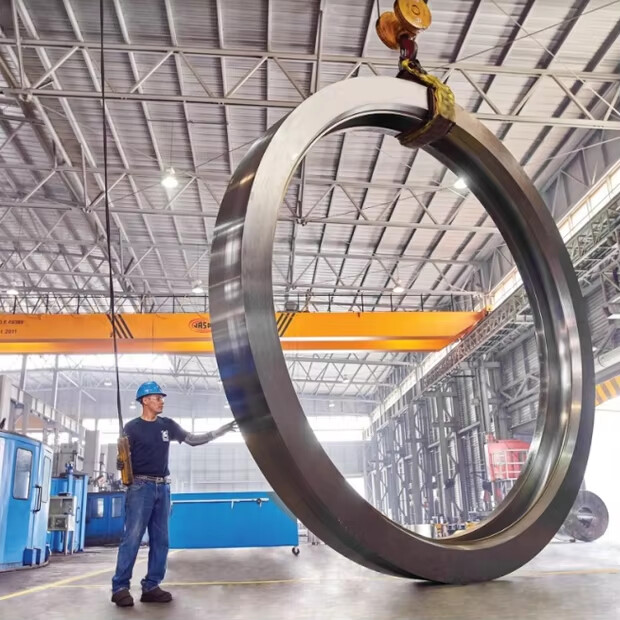
Reduces material input by 55%+ through precision forming, minimizing machining waste and lead times . Capabilities now reach:
Ring diameters up to 6000mm
Heights to 1000mm
3. Application Trends
Aerospace (50% of consumption): Landing gear, engine disks, structural components. Next-gen aircraft use 15-30% titanium by weight .
Medical: Aging demographics drive demand for forged implants (hip/knee replacements, spinal fixation). Grade 23 ELI dominates.
Marine: Subsea connectors, flange rings, desalination components. FAST-Forge enabling cost-effective adoption .
Energy: Hydrogen production, nuclear equipment, chemical processing—all requiring corrosion-resistant forgings.
Automotive: 40% weight savings vs. steel for connecting rods, valves, suspension components. EV range optimization driving interest .
4. Regional Landscape
Asia-Pacific: 44.9% market share (2025), led by China, India, Japan
North America: Aerospace and defense concentration
Europe: High-value automotive and medical manufacturing
Key Players: Precision Castparts, Howmet Aerospace, Otto Fuchs, ATI, Bharat Forge, TIMET, Kobelco . Vertical integration trend: producers expanding into forgings, forgers developing in-house alloy capabilities .
5. Industry 4.0 Integration
Smart sensors for real-time temperature/strain monitoring
Digital twins optimizing die design and process parameters
FEA simulation preventing defects before production
Closed-loop control ensuring consistency
6. Standards Snapshot
Certifications: AS9100 (aerospace), ISO 13485 (medical), ISO 9001 .
7. Challenges
Capital intensity: High equipment investment barriers
Skilled labor shortage: Limited metallurgy/operations expertise
Energy consumption: Driving efficiency improvements
Material cost volatility: Geopolitical sensitivity
Alternative processes: Investment casting and AM competing for non-critical applications
8. Future Outlook (2026-2035)
FAST-Forge commercialization expanding titanium into new markets
Aerospace recovery driving sustained demand
Defense modernization requiring advanced platforms
Medical expansion from aging populations
Green energy transition (hydrogen, nuclear) creating opportunities
Isothermal forging adoption for complex components
Bottom line: Titanium forging is becoming more accessible, sustainable, and capable. The industry's transformation—from 90% waste to closed-loop recycling—defines its trajectory for the decade ahead .
Navigation
 How can the service life of titanium plates be extended under harsh working conditions17/04/2026
 Chaoyang accelerates its ¥1.2B small-particle sponge titanium investment, with 50kt capacity boosting aerospace.16/04/2026
 Deeply engaged in the manufacturing of titanium equipment, we safeguard the development of the industry with advanced equipment and practical cooperation15/04/2026
 A New Chapter in Titanium Alloy Applications: Titanium Combs from Aerospace to Hair Care13/04/2026


Send Us A Message